
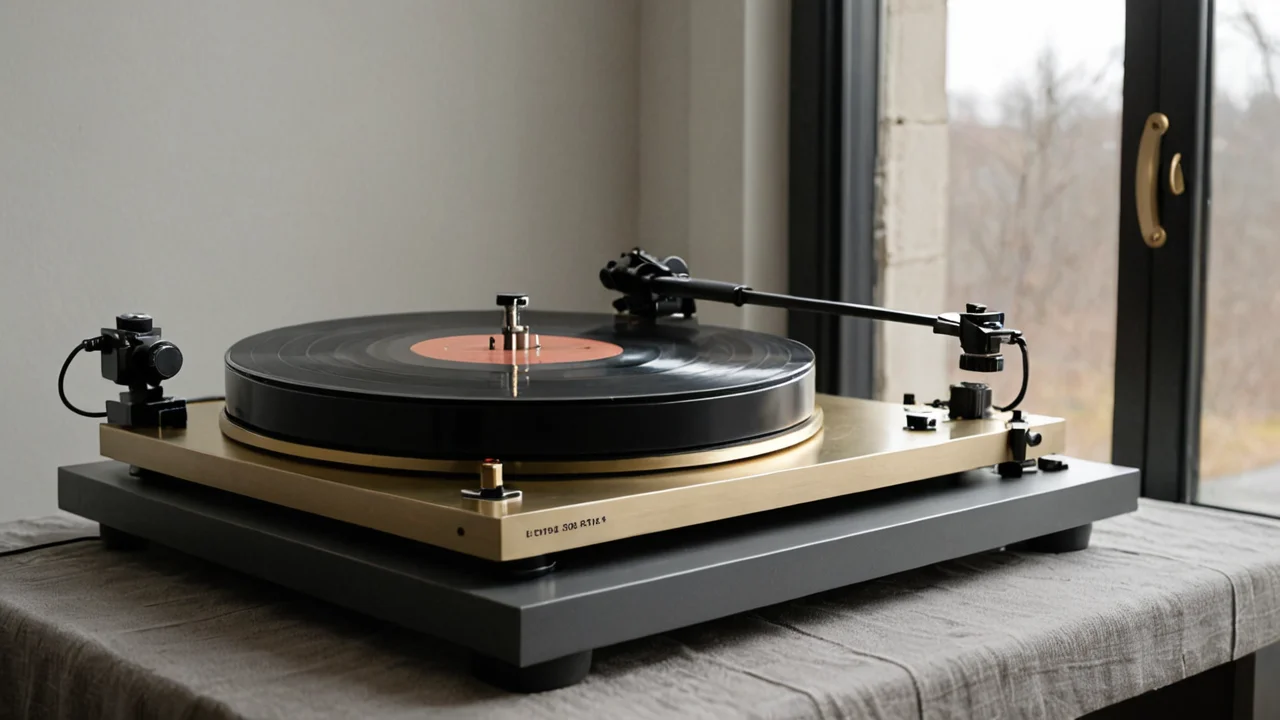


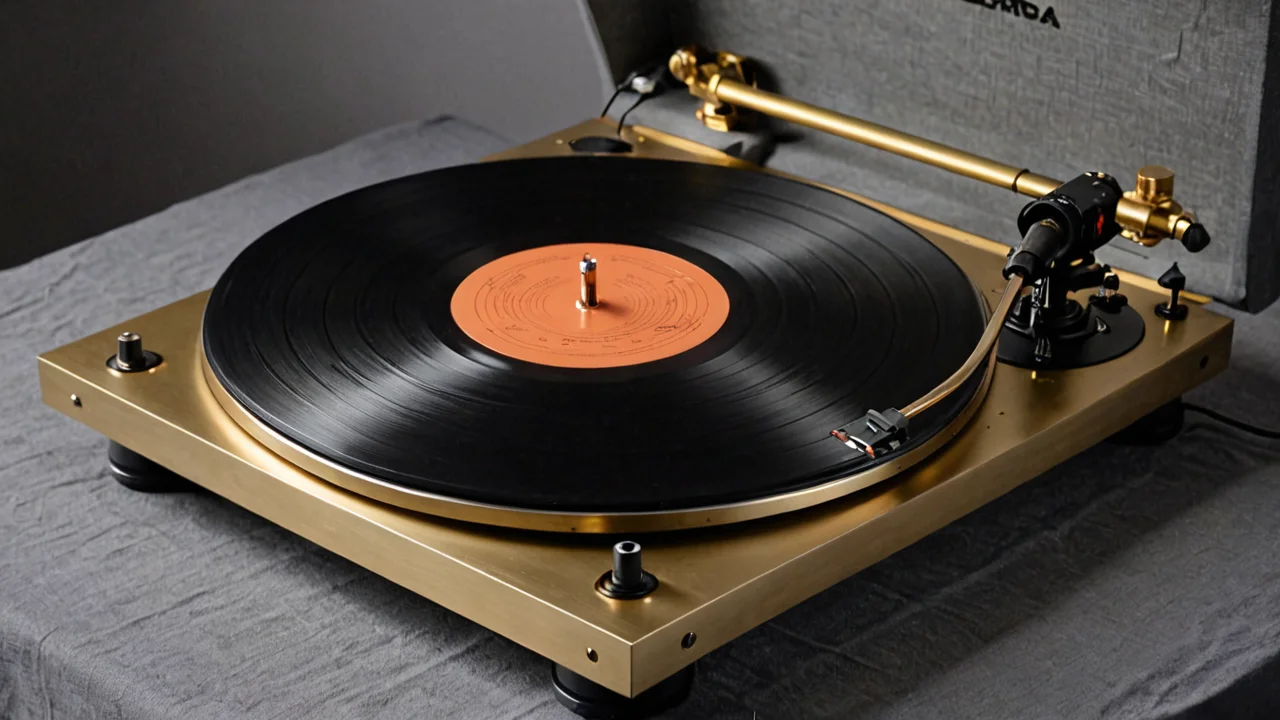
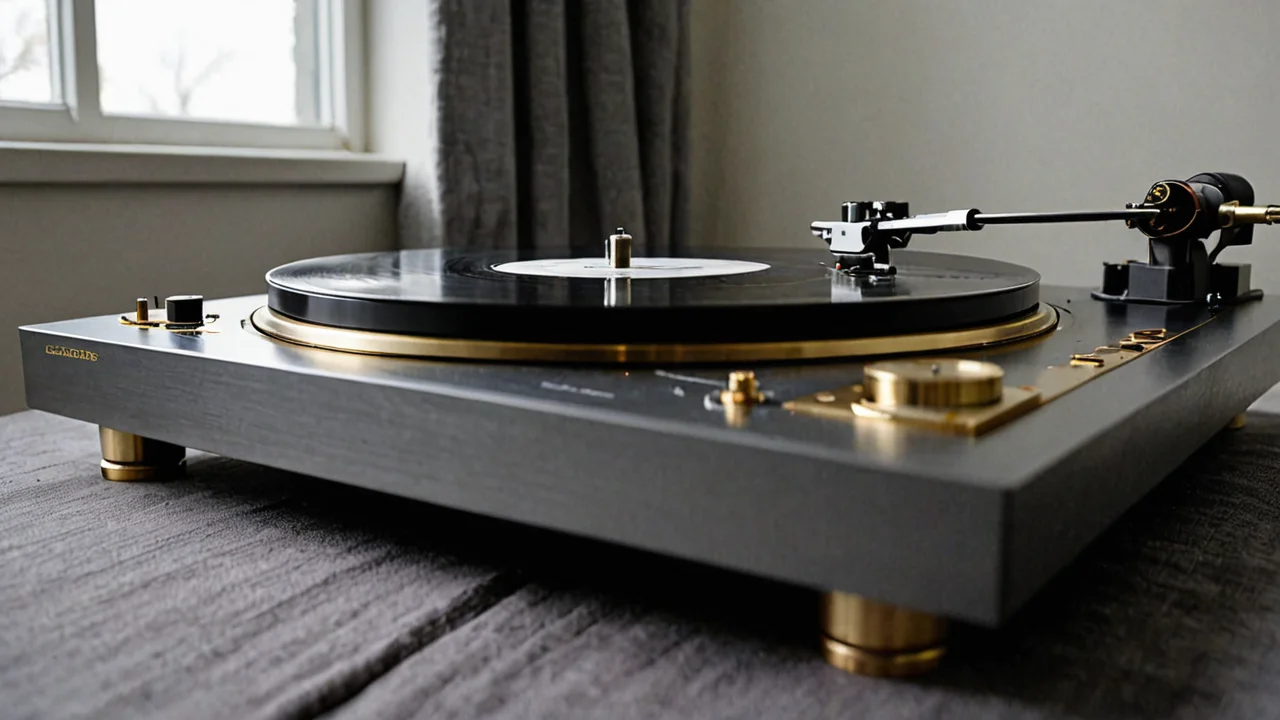

Almost every vinyl problem that gets blamed on a bad pressing, an inadequate preamp, or "digital ears" traces back to one of four mechanical settings: tracking force, vertical tracking angle, azimuth, and anti-skate. Get those wrong and the stylus mistracks in loud passages, channel balance drifts, and records wear unevenly over repeated plays. Get them right and most cartridges sound considerably better than their price suggests. The work is unglamorous, the tools are cheap, and the order matters more than the precision.
Set tracking force by the manufacturer's range, not by what sounds "open"
Tracking force is the downward pressure the tonearm and cartridge exert on the stylus, measured in grams or millinewtons, and it belongs inside the range the cartridge maker publishes. For an Audio-Technica AT-VM95E, that range is 1.8–2.2 g with a standard setting of 2.0 g; for an Ortofon 2M Red it is 1.6–2.0 g with a recommended 1.8 g (18 mN). Start at the recommended value, not at the bottom of the range, and adjust only if you have a specific problem you can hear.
The logic is a balance between two failure modes. Too little force and the stylus skips across the tops of loud modulations instead of tracing them; you hear it as sibilance that turns to spitting on "s" sounds, a hard edge on brass, or an outright jump on a warped record. Too much force and the stylus bottoms out in the groove, accelerating wear on both the record and the diamond, and the suspension inside the cartridge compresses over time. The middle of the range is where the designer expected the cartridge to work.
Measure with a digital stylus gauge that sits on the platter at record height, not a built-in counterweight scale. Counterweight markings are approximate, and the difference between the arm's idea of 2.0 g and the actual 2.0 g at the stylus can be most of a tenth of a gram. Set the gauge on the platter, lower the stylus onto its pad, and read the number. Recheck after any cartridge swap, tonearm rewire, or headshell change. A cartridge that tracks well at the recommended force will hold the groove through test records at the level the maker specifies — Ortofon rates the 2M series at 70 µm at 315 Hz at the recommended force, which is a useful benchmark if you want to confirm your setup against a test disc.
The honest trade-off: a slightly higher force within range often sounds more solid, especially on older pressings with wider grooves, and some listeners run at the top of the range deliberately. That is a legitimate choice, but it is a choice with a wear cost. Never exceed the published maximum to "cure" mistracking — if the cartridge will not track at the top of its range, the problem is alignment, anti-skate, or a worn stylus, not insufficient weight.
Vertical tracking angle is set by the arm's height, and it is the setting most people skip
Vertical tracking angle (VTA) is the angle at which the stylus meets the groove wall, and it is adjusted by raising or lowering the base of the tonearm, which tilts the whole arm tube. The AT-VM95E specifies a VTA of 23°, and the goal is to get the cartridge body roughly parallel to the record surface at that angle so the stylus sits in the groove the way it was cut. A record is cut with the stylus approaching the groove at an angle; if your playback angle is off, the stylus contacts the wall at the wrong point and you lose high-frequency detail and channel separation before you notice anything obviously wrong.
The practical method: with the stylus resting on a record, sight along the top of the cartridge body from the side. If the front is nose-down or tail-down, adjust arm height until the top surface is parallel to the record. On arms without adjustable height, shims under the cartridge or a different mat thickness are the workaround. Small deviations are tolerable — a degree or two is not audible on most conical and elliptical styli — but a visibly tilted cartridge is costing you treble and imaging.
VTA interacts with tracking force, which is why you set force first. Changing arm height changes the effective angle of the cantilever and can shift the force slightly, so recheck the gauge after any height adjustment. It also interacts with record thickness: a 180 g pressing sits higher than a standard record, which changes the angle by a small amount. Most people set VTA for their most-played records and accept the drift on the rest. That is the right call — chasing VTA per record is a rabbit hole with diminishing returns.
Azimuth and anti-skate fix the problems tracking force cannot
Azimuth is the side-to-side tilt of the cartridge in the headshell, and it controls whether the stylus sits vertically in the groove. If the cartridge is rotated even slightly, one channel reads louder than the other and the stylus wears one groove wall harder than the other. You hear it as a center image that pulls to one side, or as a vocal that sounds slightly hollow. Check it with a mirror or a small bubble level on the headshell, or by playing a mono record and confirming the image sits dead center. Adjust with the headshell screws — most cartridges have slotted mounting holes precisely for this.
Anti-skate is the counterforce that offsets the inward pull of a spinning record on the tonearm. Without it, the stylus presses harder on the inner groove wall, which distorts the right channel and wears the inner wall faster. Set it to match the tracking force as a starting point — the dial usually reads in grams for exactly this reason — then fine-tune with a test record or by listening to a mono disc: too much anti-skate pulls the image the other way and makes the sound thin. Too little and the right channel gets edgy on loud passages.
These two settings are where most "my cartridge sounds bright" and "my channel balance is off" complaints actually live. They cost nothing to check and take ten minutes. The trade-off is that neither has a single correct number printed on the box — anti-skate in particular is a compromise across the record, because the inward pull changes as the stylus moves from the outer groove to the inner. Set it for the middle of the record and accept the ends.
Alignment on the protractor is the single biggest win, and the most tedious
Cartridge alignment sets the stylus at the correct angle and position in the groove so that tracking distortion is minimized across the record. Use the protractor that matches your arm's geometry — either the one supplied with the turntable or a standard two-point protractor — and align the stylus tip to both points, adjusting the cartridge in its slots until the cantilever is parallel to the grid lines at each. This is fiddly, it takes several passes, and it is the highest-value half hour in the whole setup.
Misalignment shows up as inner-groove distortion: the last track on a side sounds harsh, sibilant, and smeared compared to the first. That is the classic symptom, and it is often mistaken for a worn record or a cheap cartridge. A well-aligned AT-VM95E, with its 20–22,000 Hz frequency response, will track the inner grooves cleanly; a badly aligned one will not, no matter what force you use. The protractor does not care about the price of the cartridge.
Two alignment geometries matter: Stevenson and Baerwald (also called Löfgren). They place the two null points at different spots on the record, trading off distortion between the outer and inner grooves. Most turntables are designed around one of them; use the protractor the manufacturer intends, or a universal one that lets you choose. The limit: alignment is only as good as the protractor's printing and your ability to sight a cantilever. A cheap plastic protractor is fine; a badly printed one is worse than none. If the cantilever is visibly skewed relative to the cartridge body, the cartridge itself is defective and no amount of alignment will fix it.
The turntable, arm, cartridge, and preamp are one signal chain and the weakest link sets the ceiling
A turntable spins the record at a constant speed and, with the tonearm, cartridge, and stylus, converts groove modulations into an electrical signal that must be amplified and equalized by a phono preamp before it reaches your speakers. Each stage imposes limits the next cannot undo. A cartridge is an electro-mechanical transducer — moving-magnet or moving-coil — that turns stylus vibration into a small voltage. The stylus is the diamond tip that rides the groove, and it is a wear item: it must be kept clean and replaced periodically to avoid damaging records. A worn stylus is the most common cause of "my records sound dull and distorted" and it cannot be fixed by any adjustment.
The practical consequence is that money spent on a better cartridge is wasted if the arm cannot control it or the preamp cannot handle its output. A moving-coil cartridge with low output needs a preamp with enough gain and the right loading; a moving-magnet cartridge is far more forgiving. Speed stability matters more than most people think — a turntable that drifts audibly will make everything sound wrong regardless of cartridge quality. Check speed with a strobe disc or an app before you spend anything on the front end.
The trade-off is real: upgrading the cartridge on a modest deck often gives a bigger audible jump than upgrading the deck itself, but only up to the point where the arm and bearing become the limit. Past that point, a better cartridge exposes the deck's shortcomings rather than fixing them. The honest sequence is: clean and inspect the stylus, verify speed, set force, alignment, azimuth, anti-skate, and VTA — in that order — before buying anything. Most setups improve more from an hour of adjustment than from a component swap.
What to measure, in what order, and what each measurement actually tells you
Work in this sequence: stylus condition and cleanliness, platter speed, tracking force, alignment, azimuth, anti-skate, VTA. Each step depends on the one before it, and doing them out of order means redoing them. A dirty or worn stylus makes every other measurement meaningless; a drifting platter makes alignment checks unreliable because you cannot trust what you hear.
What each measurement tells you, and what it does not:
- Tracking force (gauge): confirms the actual downward pressure at the stylus. It tells you nothing about whether the stylus is correctly aligned in the groove — a perfectly weighted but misaligned cartridge still distorts.
- Alignment (protractor): minimizes distortion across the record, especially the inner grooves. It does not correct a bent cantilever or a worn stylus.
- Azimuth (mirror or mono disc): confirms channel balance and even groove-wall contact. It will not fix a channel imbalance caused by a failing cartridge or a bad connection.
- Anti-skate (test record or mono disc): balances the inward pull. It is a compromise setting, not an absolute; expect some drift at the extremes of the record.
- VTA (sight along the cartridge body): confirms the stylus meets the groove at roughly the cut angle. It is a coarse setting on most arms; do not expect to hear a degree of difference.
The limits worth stating plainly: these adjustments optimize a healthy cartridge and a sound turntable. They cannot rescue a worn stylus, a bent cantilever, a failing bearing, or a preamp with the wrong gain. If a cartridge will not track at the top of its published range, or if the inner grooves distort after a correct alignment, the problem is hardware, not setup. And the precision has a floor — a digital gauge and a printed protractor get you most of the way; a mirror and a mono record get you the rest. The last few percent is not audible on most systems, and chasing it costs more time than it returns.
The reason this matters more than any single component choice is that the mechanical settings are where the signal is either preserved or lost. A cartridge with a 20–22,000 Hz response and a 23° VTA is a precise instrument; mounted carelessly, it behaves like a much worse one. Set the force to the maker's recommendation, align it on a protractor, check the azimuth and anti-skate, get the arm parallel, and then listen. If something still sounds wrong, you now know which measurement to doubt — and that is worth more than any upgrade.